


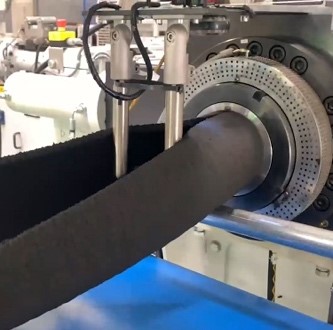
The devulcanization of rubber is a process in which the poly-, di-, and monosulfide bonds created during vulcanization are completely or partially broken, i.e. a process that causes the selective disintegration of the sulfide bonds.
The implementation of successful devulcanization is a big challenge, since the release of sulfur-sulfur (S-S) and carbon-sulfur (C-S) bonds must be broken with a twin-screw extruder and carbon dioxide injection. Of course, during the process, the breaking of a part of the carbon-carbon (C-C) bonds cannot be avoided either.
Our company has the necessary knowledge and experience to produce a controllable, permanent high-quality devulcanized rubber and a rubber compound from it according to the specific needs of customers.

The supercritical carbon dioxide injection extrusion technology is an outstanding innovative activity for the sustainability of elastomers, and is included in the Top 10 ranking of the E4S (Elastomers for Sustainability) project of the European Rubber Journal:
| Project | Title of E4S project entry | Score |
| JSR Elastomers Europe | New hydrogenated styrene-butadiene rubber | 560 |
| Nynas | New bio-based processing oil | 555 |
| UPM Biochemicals | Renewable funcional fillers (RFF) for a lighter and more sustainable future (E4S2) | 540 |
| ETB | Bio-butadiene from ethanol for tire production | 536 |
| Asahi Kasei | Hydrogenated functionalised SBC for polymer modified bitumen | 525 |
| Techsyn | New tire technology platform for improved sustainability performance | 508 |
| ExxonMobil | Specialty elastomer to enhance the barrier properties of tire innerliners | 510 |
| Versalis | Styrenic block copolymers with improved sustainability | 505 |
| Asahi Kasei | New generation styrene-butadiene rubber | 500 |
| Tyromer | Tire-to-tire recycling | 500 |
Source: https://www.european-rubber-journal.com/article/2092225/elastomers-for-sustainability-iv
Devulcanization is the peak of waste recycling
The devulcanized rubber provides the opportunity for material recovery. Devulcanization technology is the top of the waste processing hierarchy. Most rubber waste disposal methods can be considered as value-reducing recycling, each of which is a solution only if other, higher-value recycling is not possible or available.
Our company enables value-added recycling of waste tires and technical rubber waste. Compared to the currently known disposal technologies, rubber crumb processing on a twin-screw extruder with supercritical carbon dioxide is the most favorable solution for recycling waste.
